
From four seasons to a more personal understanding of colour
“Am I a Spring or a Summer?” It is a question I often encounter when people come to discover their colours. Perhaps they have already explored seasonal palettes online, but find that some of the shades recommended for their season suit them beautifully while others do not.
Personal colour analysis became widely known in the 1980s through Carole Jackson's book Color Me Beautiful, first published in 1980. The four seasons offered an accessible language for understanding colour: Spring is traditionally associated with light, warm and clear shades; Summer with light, cool and soft shades; Autumn with deeper, warmer and more muted shades; and Winter with deep, cool and clear shades.
These associations are a lovely introduction to the relationships between colours. Yet not everyone's natural colouring corresponds neatly to one of these four combinations. More elaborate seasonal systems, including those with twelve profiles, introduced further distinctions to accommodate these nuances.
Colour Me Beautiful in the UK subsequently developed its tonal approach, drawing inspiration from the Munsell colour system. This is the method in which I trained and the one I use in my practice in London.
What is tonal colour analysis?
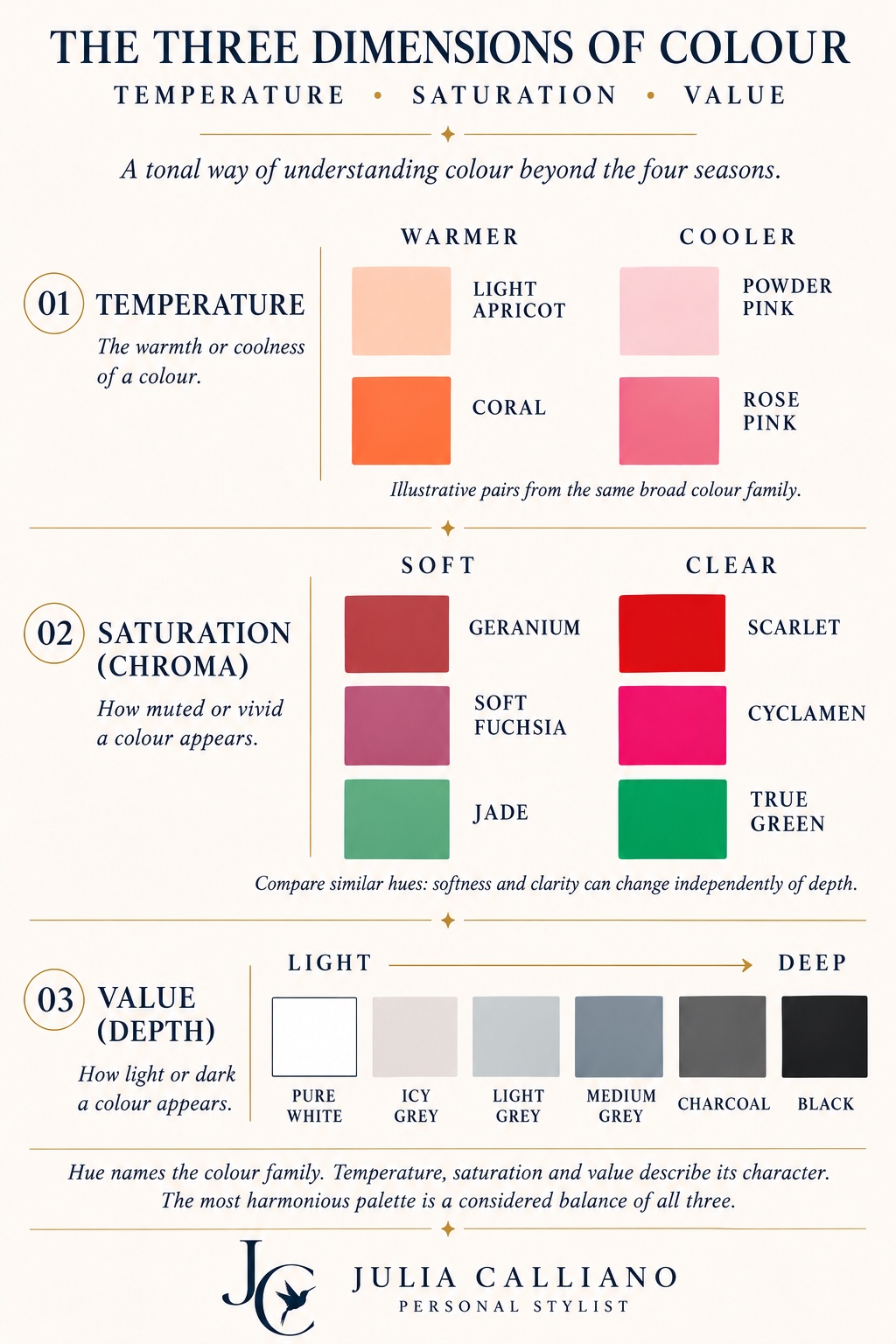
Rather than beginning with a season, tonal analysis considers the individual characteristics of colour and their relationship with your natural complexion. I work with three pairs of characteristics:
Depth: Light or Deep. How light or dark a colour is.
Temperature: Warm or Cool. Whether a colour has a warmer or cooler character in relation to other shades.
Intensity: Clear or Soft. Whether a colour appears vivid and relatively saturated, or more muted.
Every colour brings these qualities together. A blue can be light or deep, relatively warm or cool, clear or soft. Equally, our natural colouring reflects a combination of characteristics, not simply one isolated feature such as the colour of our eyes or hair.
During a consultation, we compare fabric drapes near the face in suitable daylight. I observe the overall harmony between your skin, eyes and hair and the colours we introduce. By comparing different drapes, we establish your dominant characteristic, followed by your secondary and tertiary characteristics. Their relative importance gives us a much more precise direction for your palette.
Why the order of your colour characteristics matters
Imagine a person with a light complexion, warm colouring and very little natural contrast between her features. A traditional Spring palette might contain some beautiful shades for her, yet its brighter colours could be too intense. Some muted Autumn colours might also be harmonious, but many could be too deep.
If draping establishes her profile as Light, Warm and Soft, in that order, we can guide her towards light neutrals, gentle warm accents and softer combinations of colours. The resulting advice is not simply about choosing a warm palette; it is about preserving the lightness and softness that are also important to her natural colouring.
My own colouring offers another illustration. My profile is Soft, Cool and Deep. Softness is the most important characteristic for me, followed by a cool temperature and a degree of depth. I favour muted shades with enough depth to harmonise with my features, rather than assuming that softness necessarily means pale colours.
Understanding the distinction between these three characteristics helps us recognise why two people who share a dominant characteristic may nevertheless benefit from quite different palettes and ways of combining their colours.
Knowing your colours is also knowing how to wear them
One of the aspects I particularly appreciate about tonal analysis is the practical guidance it provides beyond the selection of individual shades. How much contrast can you comfortably introduce into an outfit? Which neutrals provide a harmonious foundation? Would a tone-on-tone combination be particularly flattering, or would a more contrasting arrangement bring out the beauty of your colouring?
During Reveal Colour, we explore these possibilities with fabrics and colour combinations, and consider make-up shades where appropriate. Your personalised wallet of 42 fabric swatches and written report become references for making thoughtful choices from the clothes you already own and those you may consider buying in the future.
A palette should open up possibilities, rather than restrict you. The aim is to understand colour well enough to use it with both confidence and freedom.
Can I still find my season?
Of course. Seasonal descriptions can be useful when looking for ideas and inspiration. Once your tonal characteristics have been established, I can help you identify a comparable seasonal profile, where there is a meaningful correspondence. The two systems use different conventions, so the correspondence is not always exact.
My preference for tonal analysis comes from the way it allows me to begin with the individual, rather than with a seasonal category. It provides a framework for careful observation and for advice that is useful in everyday life.
Ultimately, discovering your colours is not about acquiring a label. It is an opportunity to recognise the beauty of your own natural colouring and to learn how to bring it into harmony with the colours you wear.
Further reading: Carole Jackson, Color Me Beautiful; Colour Me Beautiful UK, history of the tonal system; Full colour analysis.