We often say that beauty is in the eye of the beholder. And certainly, our tastes, cultures and personal histories influence what we find beautiful. But does that mean beauty is nothing more than a matter of preference?
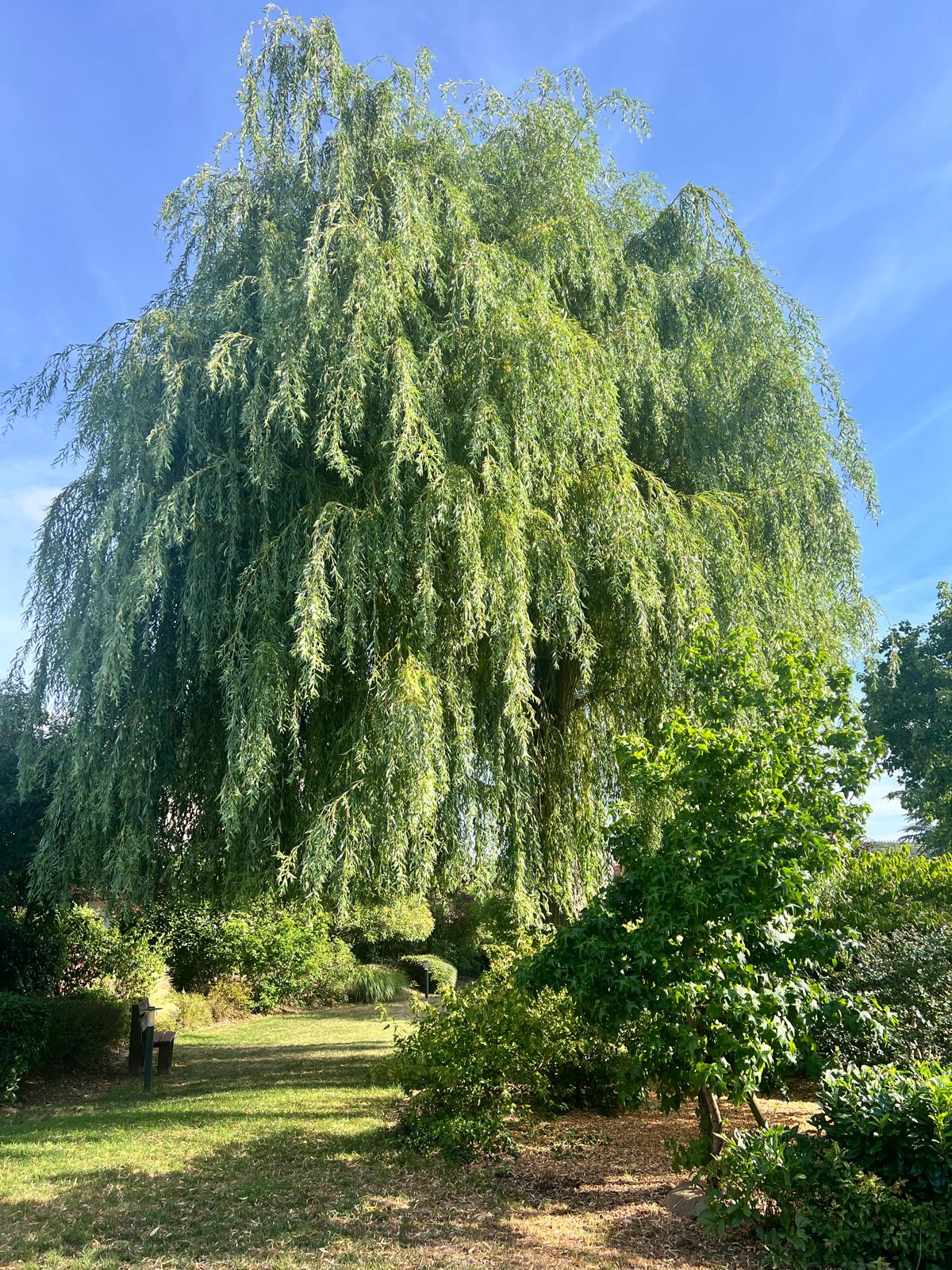
Nature has always been one of my deepest sources of inspiration. Trees and animals often seem naturally and beautifully dressed, their colours, forms and textures perfectly belonging to them. The graceful branches of a willow, the plumage of a bird or the markings of an animal all invite us to look more attentively. The willow tree in my parents' garden, photographed by my father, is a particularly personal reminder of the beauty we can discover in the natural world.
I remember spending time near Lago d’Orta in Italy, struck by the natural beauty of the landscape, the harmony of the architecture and the ease with which everyday life could seem beautiful. Experiences like these have often led me to wonder whether we can recognise certain qualities of beauty, even when our tastes differ.
Beyond personal taste
A landscape, a piece of music, a handmade vessel or a beautifully proportioned building may move us in different ways. We will not all respond alike. Yet we can still notice relationships of form, rhythm, balance and expression, and ask why something holds our attention or gives us delight.
I find the classical tradition particularly helpful here. Rather than reducing beauty to fashion, status or individual preference, it invites us to look more attentively at what is before us.
Three qualities of beauty
In the Summa theologiae, Thomas Aquinas speaks of three qualities associated with beauty: integritas, consonantia and claritas. They are often translated as wholeness, harmony and clarity or radiance. They are not a simple formula for settling every disagreement about taste, but they offer a beautiful way to begin looking.
Integritas - wholeness
A thing has an integrity of its own when it is recognisable and complete in relation to what it is meant to be. Think of a ceramic bowl: its form, material and purpose belong together. Its beauty need not depend on elaborate ornament. A simple vessel can feel entirely right.
Consonantia - harmony
Harmony concerns relationships: between parts and the whole, between scale and purpose, between what is seen and what is intended. We notice it in architecture, in the lines of a painting, in music and in the cut of a garment. Harmony does not require everything to be symmetrical or identical; it asks that the elements make sense together.
Claritas - clarity and radiance
The third quality is often expressed as radiance: something about the character of a thing becomes perceptible. Light, colour and surface can contribute to it, but in a broader reflection on beauty, I also think of the quiet clarity with which a work reveals what it is. A beautiful object can seem both unmistakably itself and generous to the eye.
And what of the beauty of a person?
This is where I think we must be especially careful. The beauty of a human person cannot be reduced to a mathematical proportion, an ideal body or a set of physical features. Our dignity does not depend on youth, health, symmetry or the clothes we wear.
Every person has a history, a temperament, a way of moving, a presence. Ageing, change and the marks of life do not take away that dignity. At times, the beauty that moves us most is found in a gesture, a smile, a quiet strength or the way someone welcomes another person.
For me, the classical language of wholeness and harmony becomes useful in personal styling only when it serves the person, rather than measuring her against an abstract ideal.
What this means for the way we dress
Getting dressed is a small act of composition. Colours relate to the complexion and to one another. Lines and proportions respond to the body in movement. Texture, scale and fabric bring their own character. The occasion, the life we lead and the people we meet also matter.
There is no single uniform of elegance, just as there is no single beautiful body. The aim is not to imitate someone else, conceal everything we dislike or pursue each new fashion. It is to understand what is naturally ours, and choose with discernment.
A carefully chosen garment may bring greater coherence to our appearance. It can help our features, our presence and our way of life speak in harmony, without taking attention away from the person who wears it.
Towards a beautiful life
The question of beauty has always seemed to me larger than appearance. It touches the way we make things, arrange our homes, cultivate our surroundings and care for one another. A beautiful life is not necessarily one filled with beautiful possessions. It may be one in which we make room for truth, goodness, generosity and attentive care.
So, is beauty objective? I believe there is more to beauty than passing taste, even though our experience of it is personal and never exhausted by a set of rules. Perhaps the most fruitful question is not whether everyone will agree with our judgement, but whether we can learn to see more clearly, choose more thoughtfully and bring a little more beauty into everyday life.