When beautiful clothes do not feel like you
Have you ever admired a garment in a shop, only to discover in front of the mirror that, although it fits you well, something about it does not feel quite right? Perhaps it is too formal, too elaborate, too conventional or too bold. The same garment might look entirely natural on someone else.
We often notice people whose way of dressing seems to come effortlessly to them. Their clothes speak a recognisable language, and there is a sense of coherence between their appearance and the person we encounter. What makes that possible?
Understanding your natural colouring and proportions is an important part of finding your style. But there is another dimension to consider: the way your character, preferences and sensibility find expression through clothing.
Six expressions of style personality
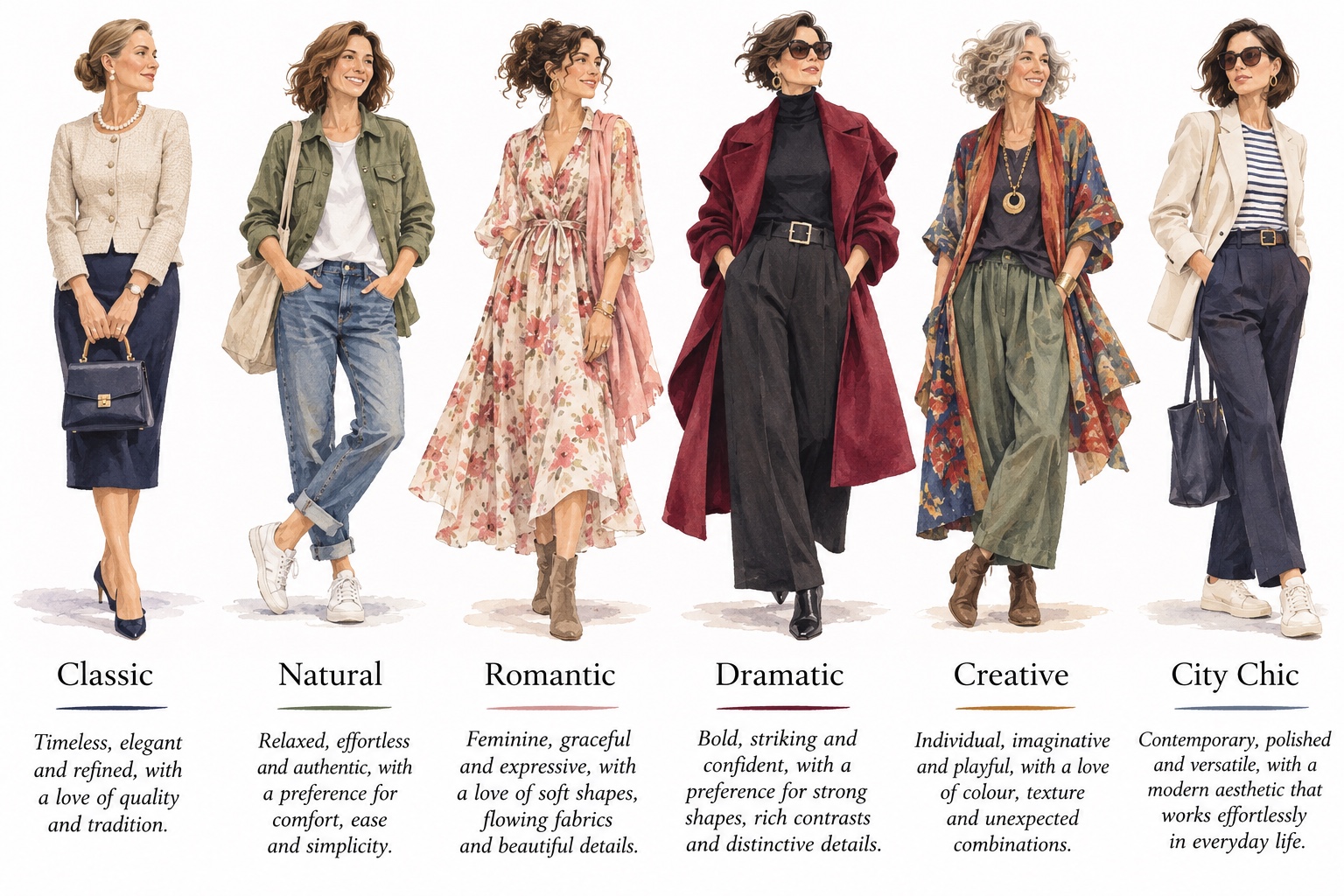
In the Colour Me Beautiful approach in which I trained, six familiar style personalities offer a useful starting point for exploring our clothing preferences. You may recognise yourself in several of them.
Natural. A preference for ease, practicality and uncontrived beauty. Comfortable shapes, tactile materials and simple combinations may hold particular appeal.
Classic. An appreciation of enduring designs, balanced proportions and carefully coordinated pieces. A well-cut jacket or an elegant, familiar silhouette can bring a sense of order and refinement.
City Chic. A love of contemporary elegance, clean lines and carefully chosen details. A relatively restrained outfit may derive its interest from the quality of its materials or the precision of its cut.
Romantic. A sensibility drawn to softness, grace and feminine details. Delicate jewellery, flowing fabrics or a beautifully rendered floral pattern may express this preference.
Dramatic. An enjoyment of visual impact, distinctive silhouettes and bold choices. A striking accessory or sculptural garment can give an outfit a strong sense of presence.
Creative. A curiosity about unexpected combinations, textures, patterns and artistic details. A handmade accessory, an unusual construction or an imaginative way of wearing a familiar garment can provide particular pleasure.
These are descriptions of aesthetic preferences, not psychological diagnoses or fixed categories of human personality. No one expression is more valuable or more elegant than another.
One person, many possibilities
A person may have a very practical approach to dressing and yet love romantic details. Someone who appreciates classical tailoring may also enjoy the originality of a beautifully crafted piece of jewellery. The interest lies in the relationship between these qualities, and in finding a way for them to coexist harmoniously.
My own style, which I describe as Natural Feminine Chic, has evolved in this way. I have always appreciated simplicity, comfort and natural materials, while being drawn to expressive colours, handmade jewellery and feminine details. Over time, I have come to express these same preferences with a more refined simplicity.
Recognising a combination of style preferences does not mean collecting more clothes to represent each of them. It can help us understand which details matter most to us, and which we may happily leave behind.
Look beyond your wardrobe
When trying to understand your own style, I would encourage you to look beyond fashion. Which works of art attract your attention? What kinds of places make you feel particularly at home? Which materials, architectural lines, gardens or objects do you find beautiful? Are you drawn to restraint or abundance, to delicate details or more sculptural forms?
These observations may help you recognise a recurring aesthetic language. They may also reveal differences between what you appreciate in others and what feels natural for you to wear.
Your culture, memories, values and interests all have a place in this reflection. So do your professional responsibilities, relationships and everyday circumstances. Personal style is not simply a private expression of taste; it is also part of the way we present ourselves to the people we encounter.
Bring your preferences into harmony with your natural features
It is possible to appreciate a particular aesthetic without adopting every garment associated with it. Someone drawn to romantic style might prefer a softly draped blouse or a delicate detail rather than abundant ruffles. Someone who enjoys dramatic expression might choose a striking piece of jewellery in a harmonious colour and scale rather than an entirely bold outfit.
Understanding colour, proportion, fabric and fit helps us translate our preferences into clothing choices that work with our natural features. It also helps us adapt those choices thoughtfully to different occasions, without feeling obliged to adopt a different personality for each one.
During Reveal Style, a questionnaire and conversation help us explore these preferences alongside the technical analysis of your natural lines and proportions. We can then use garments and examples to understand how these discoveries work together in practice.
From a style personality to a personal signature
For those who wish to explore this dimension further, Signature Style is a reflective consultation following Reveal or Engage. We take time to consider your character, convictions, aesthetic sensibility and the life you lead, and translate these reflections into a personal Style Compass.
My intention is not to give you another label to live up to. It is to help you recognise what is genuinely yours, so that you may choose with increasing clarity, freedom and consideration.
Finding your style is ultimately not mainly about fashion or shopping. It is about knowing yourself better, and allowing something of who you are to become visible to others.
Further reading: Colour Me Beautiful: discovering your style personality; Becoming more fully myself.